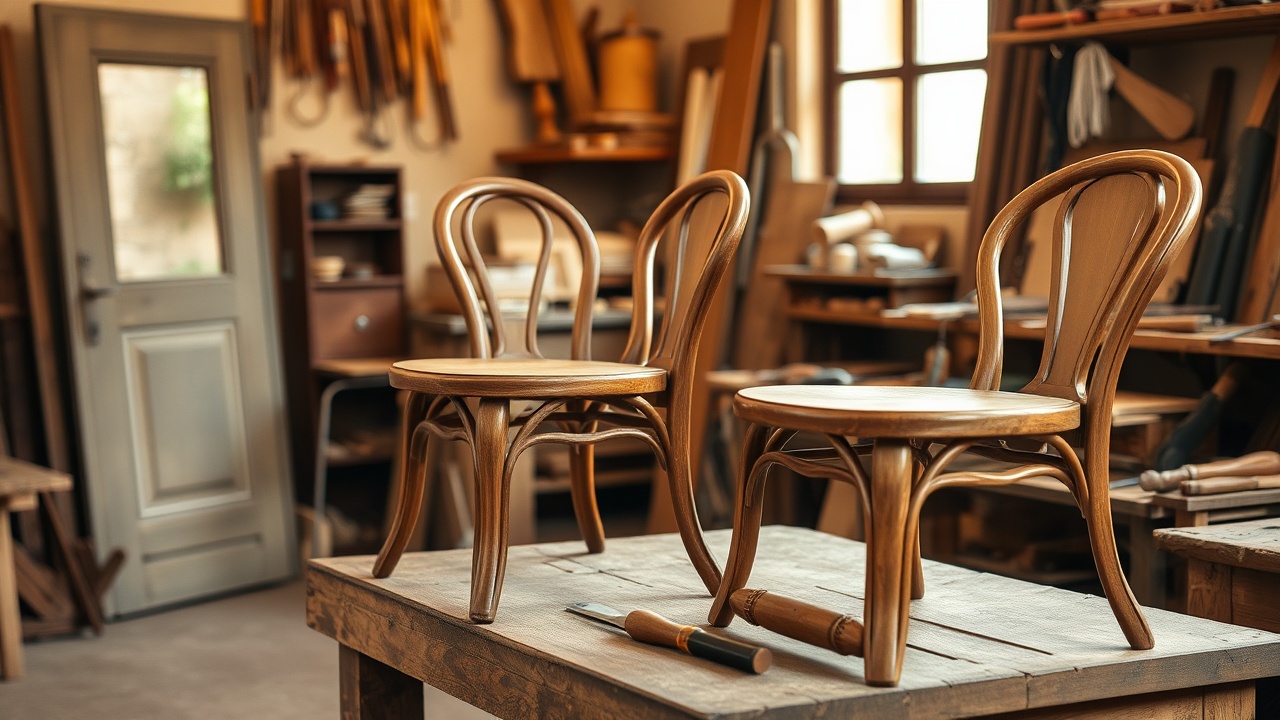
There are currently nineteen chairs in varying stages of restoration in my family's farmhouse in Umbria. My mother has stopped asking about them. Johan, who visits occasionally and is in charge of our project schedules, has taken a philosophical position on the matter. The chairs were not planned. They accumulated.
It started in 2018 with a set of six dining chairs I found at an estate sale near Perugia — Austro-Hungarian bentwood, probably 1900 to 1910, the kind of thing that was in every Italian farmhouse kitchen for fifty years and then got replaced by plastic stacking chairs in the 1970s. Three were structurally sound; three needed the joints reglued and one needed a rear leg replaced. The upholstery — a synthetic fabric in a pattern that had nothing to do with anything — was removed and replaced with a natural linen in a colour close to the original rush seats that the chairs would have had. The whole project cost about €240 in materials and took four weekends.
I mention the cost because it's often the first question, and also because it illustrates why restoration is dramatically undervalued as a design strategy.
The economics, briefly
A new dining chair of comparable quality to a well-made 1900s bentwood piece — solid beech construction, traditional joinery, upholstered seat — costs somewhere between €400 and €900 from a quality European manufacturer. A set of six runs €2,400 to €5,400. The bentwood chairs I restored cost €80 each at the estate sale, plus materials. The result is a set of chairs that are better made than anything available new at that price and that have a specific history — they came from somewhere, they sat around someone's table for a hundred years, and that is visible in them in ways that are impossible to fabricate.
This arithmetic holds across most categories of pre-war European furniture: dining chairs, wooden bed frames, wardrobes and armoires, upholstered armchairs and sofas with solid frames. The labour cost of restoration is real, and if you're paying a professional restorer the hourly rate is not cheap. But you're comparing it against the full purchase price of new furniture, and the new furniture — unless you're at the very top of the market — is almost certainly made with laminated components, dowel joinery, and foam upholstery that will not last forty years, let alone a hundred.
What we actually advise clients to keep
When we start a project, we ask to see everything the client is considering replacing. Not because we're attached to old things as a category — there's plenty of old furniture that's ugly and poorly made and should go — but because we've learned that clients often plan to replace things they'd regret losing, and keep things that should go.
Things worth keeping and restoring, almost always: pre-1960 solid wood pieces (wardrobes, chests, tables, chairs) that have good bones even if the finish is wrong. Mid-century pieces by makers with documented quality — even without a famous name, a well-made postwar Italian or Scandinavian piece is usually worth the trouble. Upholstered pieces with solid hardwood frames where the structural elements are intact.
Things not worth restoring: anything made with particleboard or MDF at its core. Furniture that's structurally sound but fundamentally the wrong proportion or the wrong character for the room. Sentimental pieces that aren't actually good and that the client is keeping out of obligation rather than love. (This last category is delicate to navigate, but it's important. A dining table inherited from a grandmother who the client didn't particularly like is not adding anything to the space.)
The craft of restoration
Most furniture restoration work falls into three categories: structural repair, surface treatment, and reupholstery. Structural repair — regluing joints, replacing broken parts, stabilising frames — is the most straightforward if you have the right adhesives and clamps and the patience to work slowly. Hide glue is the correct adhesive for traditional furniture; it's reversible, it's been used for this purpose for centuries, and it bonds wood to wood better than most modern alternatives. PVA works in an emergency. Epoxy is usually wrong.
Surface treatment is where most amateur restorations go wrong. The instinct is to strip everything back to bare wood and refinish from scratch, which produces furniture that looks new — which is not the same as looking right. Old surfaces have layers of wax, oil, and oxidation that produce a warmth and depth that a fresh finish can't replicate. The correct approach for most pieces is to clean the existing finish gently (diluted shellac thinner on a rag, usually), address specific damage points with tinted wax or shellac drops, and consolidate what's there rather than replacing it.
Reupholstery is a separate craft that takes time to learn. The structural approach — webbing, springs, wadding, top fabric, applied in the right sequence — hasn't changed much since the 19th century. What has changed is the availability of materials: traditional jute webbing and horsehair padding are available from specialist suppliers, but you have to know to ask. The natural alternatives age better and feel better than their synthetic counterparts. A seat upholstered in horsehair and covered in a quality wool or linen will outlast a foam-and-polyester seat by decades.
When restoration becomes something else
There's a point at which restoration shades into fabrication — where so much has been replaced that the object is no longer really the original thing, just a new thing made using old parts. I don't think this is necessarily wrong, but it's worth being clear about what you're doing. A chair where the frame is original but the joinery has been reglued, the seat replaced, and the finish redone is still the original chair. A chair where a leg has been replaced and the seat rebuilt is still the original chair. A chair where three legs have been replaced, the back rail remade, and the frame entirely reglued with new timber is something closer to a reproduction that contains some original material.
For practical purposes, this distinction matters mainly when the furniture has documentary or monetary value — antique pieces that are being considered for resale, or family pieces where provenance matters to the family. For design purposes, for the everyday business of furnishing a house, it's largely irrelevant. The chair either works or it doesn't. The patina is either honest or it isn't. Those are the questions worth asking.
The nineteenth chair in Umbria is a 1940s upholstered armchair with a cherrywood frame that I found at a market in Città di Castello in March. The frame is perfect. The upholstery is genuinely beyond saving. I have the fabric chosen — a heavy wool bouclé in a brownish-green that will work with the room. I have not started the work yet, which means I am technically still within the definition of "in progress" that I apply loosely to all nineteen.
By the time this post goes up, there will probably be twenty.