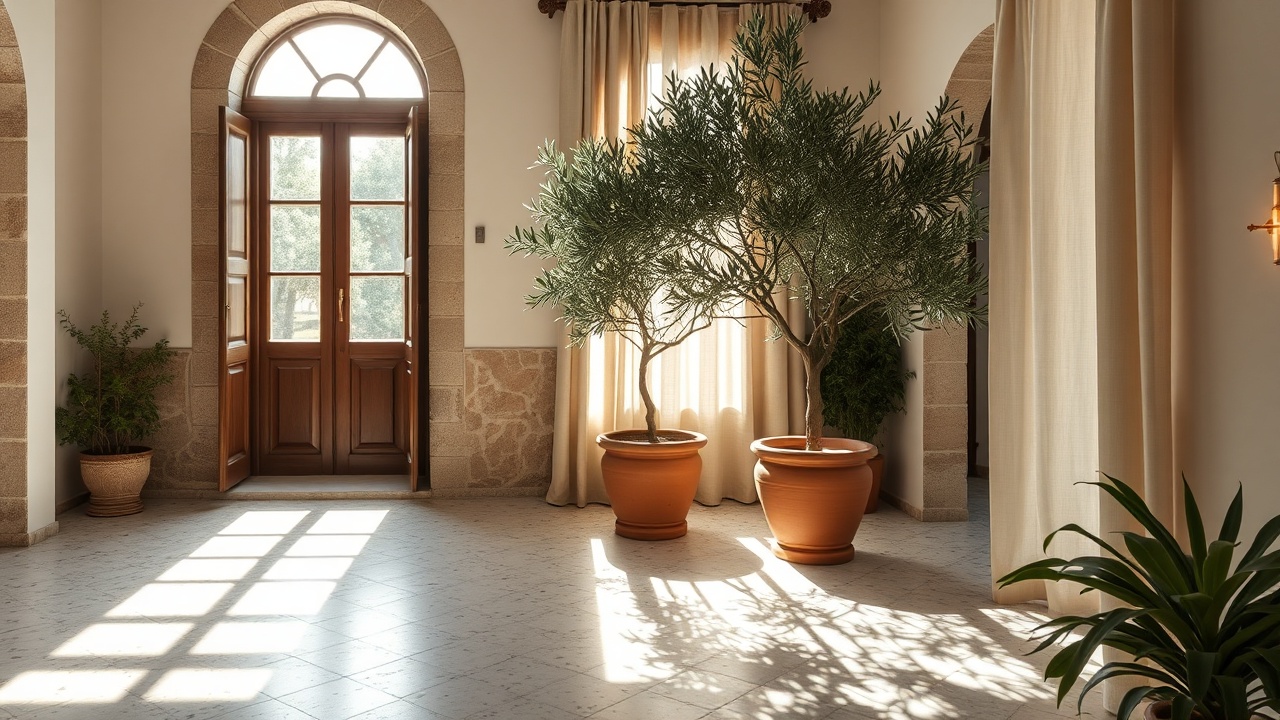
The Como Residence client asked us, during our second site visit, whether we planned to incorporate "biophilic elements." We said yes, but that we probably meant something different by it than the term usually implies. She looked mildly suspicious. By the end of the project, she'd stopped using the word entirely, which I take as a compliment.
Biophilic design has become a marketing term, which is unfortunate because the underlying idea is correct. Humans are more comfortable, more alert, and less anxious in environments that have characteristics associated with the natural world — varied texture, natural light that changes over time, the presence of living materials, acoustic softness, spatial complexity. These are not opinion; they're reasonably well-established in the environmental psychology literature going back to E.O. Wilson's work in the 1980s. The problem is that the design industry has compressed this rich body of research into a handful of photogenic gestures: a large plant, some exposed stone, a lot of unbleached linen, possibly a moss wall.
None of those things are wrong, exactly. They're just not doing the actual work.
What actually works
The strongest biophilic intervention in any interior is almost certainly light — specifically, light that changes. A room that has the same quality of light at 8 a.m. and 6 p.m. is doing something subtly wrong that no amount of plants will fix. The circadian signal is missing. The room doesn't know what time it is, and neither, quite, do you.
At Como, the villa had been retrofitted with recessed LED lighting — the kind of flat, even, 4000K illumination that reads as modern and is completely inert. We replaced it entirely with a layered system: warm-toned ambient lighting (2700K) supplemented by directional accent lights on a separate circuit, with a programmable dimmer sequence that shifts the balance through the evening from relatively bright and even to pools of warm light by 9 p.m. None of this is expensive technology. A competent electrician and a reasonable lighting designer can do it in any residential project. The effect is immediate and substantial.
The second most effective intervention is texture at the tactile scale — surface variation that registers when you run your hand across it, or even when you simply look at it. Smooth white walls are visually neutral and tactilely dead. The lime plaster we use in most of our projects has a surface variation of perhaps 0.5 to 1.5 mm — imperceptible in a photograph but very much present in a room. The difference in how a space feels is real and difficult to explain to clients before they experience it.
The plant question
The Como client wanted twelve houseplants per room. This is not an exaggeration — she brought a Pinterest board. We had a long conversation about this, which ended in three large plants in the ground-floor salon, two in the kitchen, and one in the main bedroom. The rest were abandoned not because plants are wrong but because the specific plants she'd chosen (various large-leaf tropicals) were wrong for the light conditions of a lake villa in northern Italy, where the winter is genuinely dark, and because twelve plants in a room of that scale would have made it feel more like a greenhouse than a home.
The plants we chose were positioned near windows where the light was actually sufficient. Two of the three salon plants are fig species — not the fashionable fiddle-leaf (Ficus lyrata) but Ficus benghalensis 'Audrey', which is substantially more tolerant of variable light and does not drop its leaves dramatically when moved. The third is a large Monstera deliciosa that has been in the family for years and was brought from the client's Amsterdam apartment. It knows how to be a houseplant.
The strongest biophilic intervention in any interior is almost certainly light — specifically, light that changes. A room that has the same quality of light at 8 a.m. and 6 p.m. is doing something subtly wrong.
Materials as biophilic elements
This is where Italian material culture has an advantage that's easy to underestimate. Stone, wood, wool, linen, terracotta, lime — these materials have surface variation, thermal mass, acoustic properties, and aging characteristics that are fundamentally different from their industrial substitutes. They don't just look natural; they behave in ways that read as natural at a sensory level that design photography rarely captures.
The terrazzo floors at Como, once restored, have a quality of light reflection that shifts with the angle of the sun. In the morning, the grey aggregate reads as cool and architectural. In the afternoon western light, the same floor has warmth. No composite floor covering does this. The variation isn't random — it's the result of decades of polishing and use creating micro-surface differences that scatter light differently.
When we specify materials in this context, we're making a decision that will be felt rather than seen. The acoustic difference between a room with stone floors and heavy wool textiles versus one with hardwood floors and synthetic curtains is substantial — the former absorbs sound differently at different frequencies, producing a quality of quiet that the latter never achieves. Clients rarely articulate this directly, but they often say that a room "feels calmer." It usually does.
What we don't do
We don't install living walls. The maintenance requirements are significant, the failure rate in residential settings is high, and in our experience the visual effect deteriorates within 18 months in most installations. If a client specifically wants one and understands the commitment, we'll work with a specialist. We don't proactively recommend them.
We don't use "biophilic design" as a selling point in our proposals. The term has been used to justify so much that it's become meaningless in a commercial context. We'd rather show the work and let the result speak, as we tried to do with Como and the Navigli apartment.
What we do instead is ask, in the early stages of every project: what time of day does this room matter most, and what does it need to feel like when it matters? The answer to that question — not a style board, not a trend forecast — is what shapes the light, the materials, and eventually the sense of being in a room that feels right.