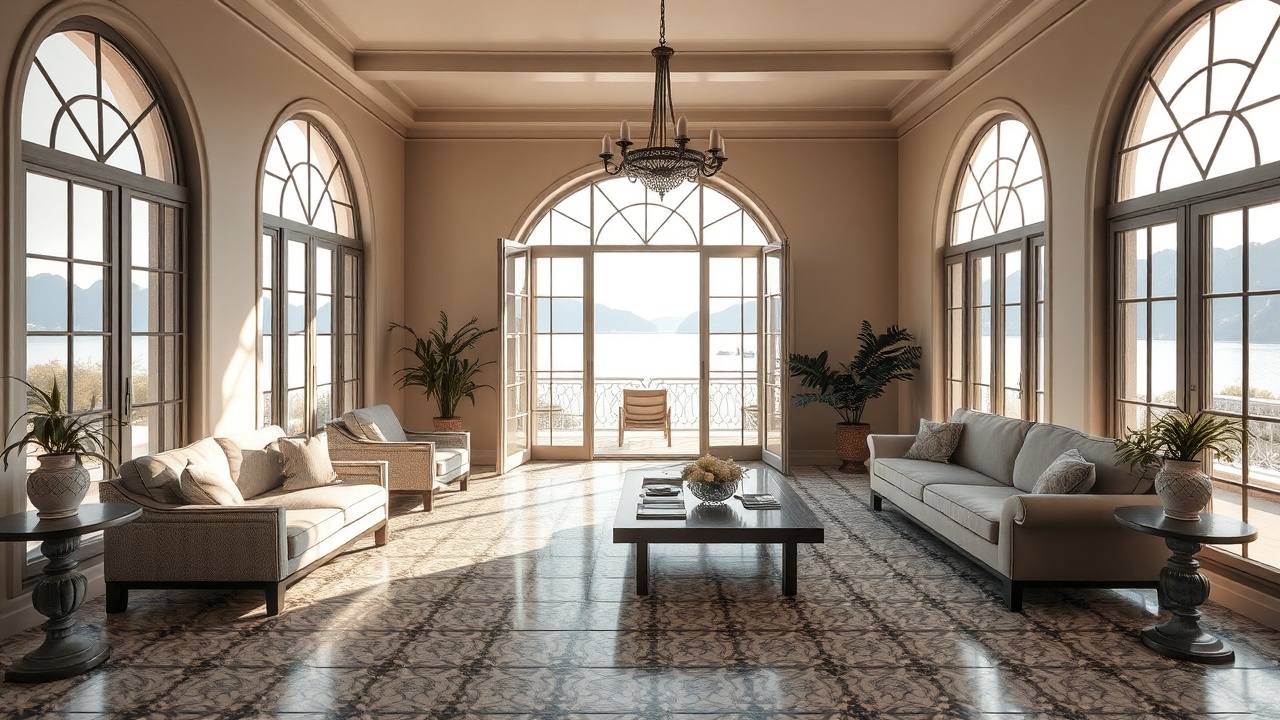
The situation
The villa was built in 1934 by an architect whose name nobody could establish with certainty — the documentation was lost during the postwar period. What was clear from the structure was that whoever designed it had strong opinions about the relationship between interior and exterior: every principal room faced the lake, and the windows were large cast-iron frames that had been positioned to frame specific views rather than simply provide light. The building knew what it was doing.
By the time our clients purchased it in 2022, sixty years of successive renovation had obscured most of the original decisions. Acoustic ceiling tiles in the main salon. Wall-to-wall carpet over the original terrazzo. A dropped ceiling in the staircase hall that had reduced the volume from three metres to two-four. A kitchen added in what had clearly been a service room, tiled in the style of a 1980s hotel. The building still knew what it was doing — it was just very hard to see.
Strategy: archaeology first
Our first recommendation was to spend the initial two months doing nothing but removing things. The clients had expected design proposals and material samples. Instead we gave them a skip and a crowbar and asked them to trust us. By the end of week six, the original terrazzo floors had re-emerged across most of the ground floor — a geometric pattern in grey, black, and bone white that was in almost perfect condition under the carpet. The staircase hall had its ceiling restored. The cast-iron windows in the salon had been painted over seven times; we stripped them back to the original dark bronze finish, repaired two that had corroded through, and had a local metalworker fabricate replacement fittings that matched the originals.
The terrazzo required specialist restoration. Terrazzo from this period was polished differently than modern versions — the aggregate is finer and the finish is achieved through repeated manual polishing rather than mechanical grinding. We found a craftsman in the Como area who still does this work using methods he learned from his father. The process took three weeks for the ground floor alone, but the result is a surface that reflects the lake light in a way that no modern floor covering could.
New work in an old shell
The kitchen was the main area where new work was needed. The original service room — which the kitchen had awkwardly colonised — had good proportions and a north-facing window that kept it cool through the summer. We rebuilt it entirely: polished concrete countertops, solid oak cabinetry in a warm grey-green, and a single run of open shelving in hand-hammered steel. The appliances are fully integrated. The refrigeration is split between two under-counter units rather than one tall fridge — a choice driven partly by aesthetics and partly by the practical reality that the north-facing room stays cool enough for wine without refrigeration from October to April.
The three bathrooms were each treated differently depending on their position and light. The main bathroom on the first floor, which faced the lake, received the most attention: walls in Ceppo di Gré — a limestone from Bergamo that has a soft, sedimentary texture and ages beautifully in humid environments. The second bathroom was simpler: white Carrara throughout, which felt right for a smaller, north-facing room. The third, a shower room added in the 1970s, was stripped and rebuilt in dark Nero Marquinia marble — partly as a contrast and partly because the client's son, who uses the room, specifically asked for something that felt different from the rest of the house.
What the clients said
When we handed over in October 2024, the clients said they felt they understood the house for the first time. This is the outcome we aim for in every restoration project: not a house that looks better than it did, but a house that is finally legible — where the decisions that were made in 1934 can be understood and appreciated alongside the decisions made in 2024.