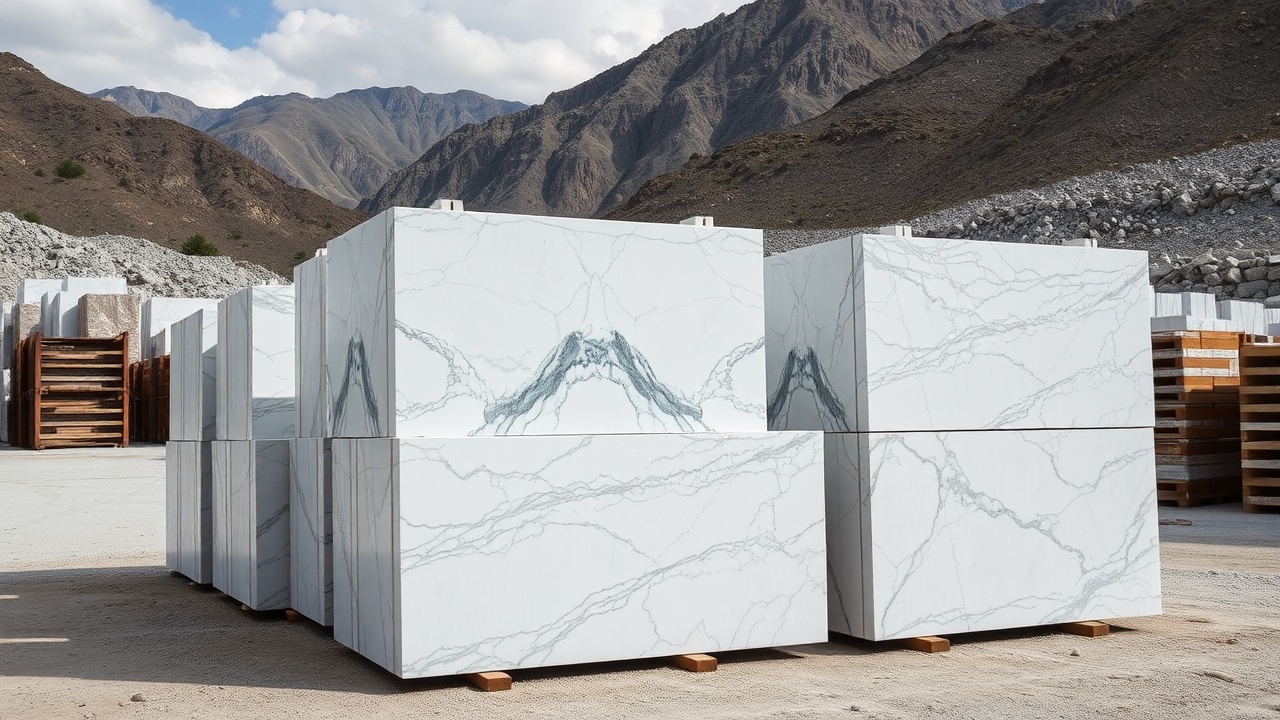
In February we spent three days in the Apuan Alps above Massa Carrara with a stone consultant named Aldo who has been working these quarries since 1987 and who treats anyone who specifies "Calacatta" without qualification with the kind of patient contempt that only comes from thirty-eight years of watching people get it wrong.
This is a written version of what we learned, because we've had the same conversation with clients about four times in the past year and it seems worth putting down somewhere permanent.
What "Carrara marble" actually means
Carrara is a region, not a variety. The Apuan Alps produce somewhere in the range of three hundred distinct named varieties of marble, and the number of unnamed or informally named varieties is considerably higher. When a client tells you they want "Carrara marble," they have told you approximately as much as someone who says they want "Italian wine" — technically accurate, practically useless.
The names you hear most often in specification documents are Bianco Carrara, Statuario, Calacatta, and Arabescato. These are real distinctions, but they're also commercial categories that get stretched considerably in practice. Aldo showed us three samples all labelled "Calacatta Gold" by three different suppliers. They were visibly different stones. Two of them were probably not from Carrara at all.
"Calacatta is whatever someone decides to call Calacatta that week. Statuario is more controlled. Bianco Carrara you can trust because it's too common to bother faking."
The practical implication for specification is this: if you're writing "Calacatta Gold" into a contract without a quarry reference, a slab reference, or at minimum a physical sample that you've approved, you have specified nothing. The contractor will buy whatever is available at the price that works for their margin, and it will probably be fine, and it will probably not be what you imagined.
How blocks become slabs
The quarrying process starts with wire saws cutting blocks from the mountain face — typically 2.5 to 3 metres in each dimension, weighing somewhere between 15 and 25 tonnes. These go to a processing yard where they're cut into slabs, usually 2 cm or 3 cm thick, by multi-wire gang saws. A single block might produce 60 to 80 slabs, and the critical thing to understand is that the vein pattern changes dramatically through the block.
The first slabs cut from a block will have one face of the vein structure. The slabs cut from the middle of the block will look completely different. The last slabs will look different again. If you need matched slabs — for a continuous kitchen counter, or for the walls of a shower enclosure — you need slabs that are sequential cuts from the same block, and you need to see them yourself, in person, laid out on the ground in sequence before you commit.
This is not something you can do from a photograph. The camera flattens the veining and changes the colour. We have clients who have approved marble remotely and been surprised by what arrived. We understand the temptation, particularly for projects outside Italy. We still don't recommend it.
Minimum orders and the single-residence problem
Here is where it gets practically difficult for residential projects. The quarry yards that hold the most interesting material — and by interesting I mean the tightly controlled lots with documented provenance and consistent quality — typically operate at a commercial scale. Minimum block orders. Multi-project lot commitments. Relationships that have been built over years.
When we started working in this region in 2020, we couldn't access these yards on behalf of a single residential client. The orders were too small and we had no track record. It took three years of regular visits, a handful of referrals from a restoration architect we know in Florence, and a certain amount of buying stone we didn't immediately need to build the relationships that now allow us to specify from yards that most residential designers never see.
This is why our material sourcing service exists. It's not a convenience offering — it's the result of years of work that most practices don't do because it takes time that doesn't immediately appear on an invoice.
What Aldo told us about pricing
Marble pricing is opaque in ways that benefit intermediaries. The quarry price, the yard price, the distributor price, and the retail price can vary by a factor of three or four for materially identical stone. The reasons are partly legitimate (logistics, stock holding, risk) and partly not.
What we've learned to do is anchor to the yard price on material we buy regularly, which gives us a reference point for evaluating what distributors are charging. On a substantial kitchen or bathroom spec, this reference point is worth having. On a small project where the stone budget is modest, the overhead of building that knowledge probably doesn't pay for itself.
Aldo's view — and he has no particular reason to be diplomatic — is that about 30% of the markup in the distribution chain is friction and 70% is margin. Whether that's exactly right, the general direction is accurate from our experience.
Practical notes for specifiers
- Always specify the quarry and the lot if you can. "Statuario from Henraux, lot 2024-08" is a specification. "Statuario" is a category.
- For matched slabs, visit the yard. If you can't visit, send someone you trust.
- Ask for the booking number for your block. Legitimate yards have one. If they can't give you one, ask why.
- Bianco Carrara is the most commoditised and the easiest to source consistently. Calacatta is the most variable and the most frequently misrepresented. Statuario sits in between.
- Veining photographs badly. Approve from physical samples or in person.
- Plan for quarry lead times of 8–14 weeks from approval to delivery in Northern Europe. Less to Italian sites, more if the block needs to be cut to a specific dimension.
We'll be making another sourcing trip to the Carrara region in June. If you have a project that would benefit from us looking at specific material while we're there, get in touch before May.