The brief
The clients — a Belgian couple who had owned the property since 2009 — came to us with a specific problem: they'd spent fifteen years trying to restore the farmhouse themselves, and each decision had been made in isolation. The main house had good bones but an incoherent interior: mid-century furniture bought online sat next to reproduction Tuscan pieces, the kitchen had been renovated twice without ever solving its layout problem, and three different contractors had tiled three different bathrooms in three different styles. The place felt like an argument no one had won.
Their brief was simple to state and difficult to deliver: make it feel like it had always been this way. Not a museum, not a showpiece — a house that belonged to where it was.
Approach
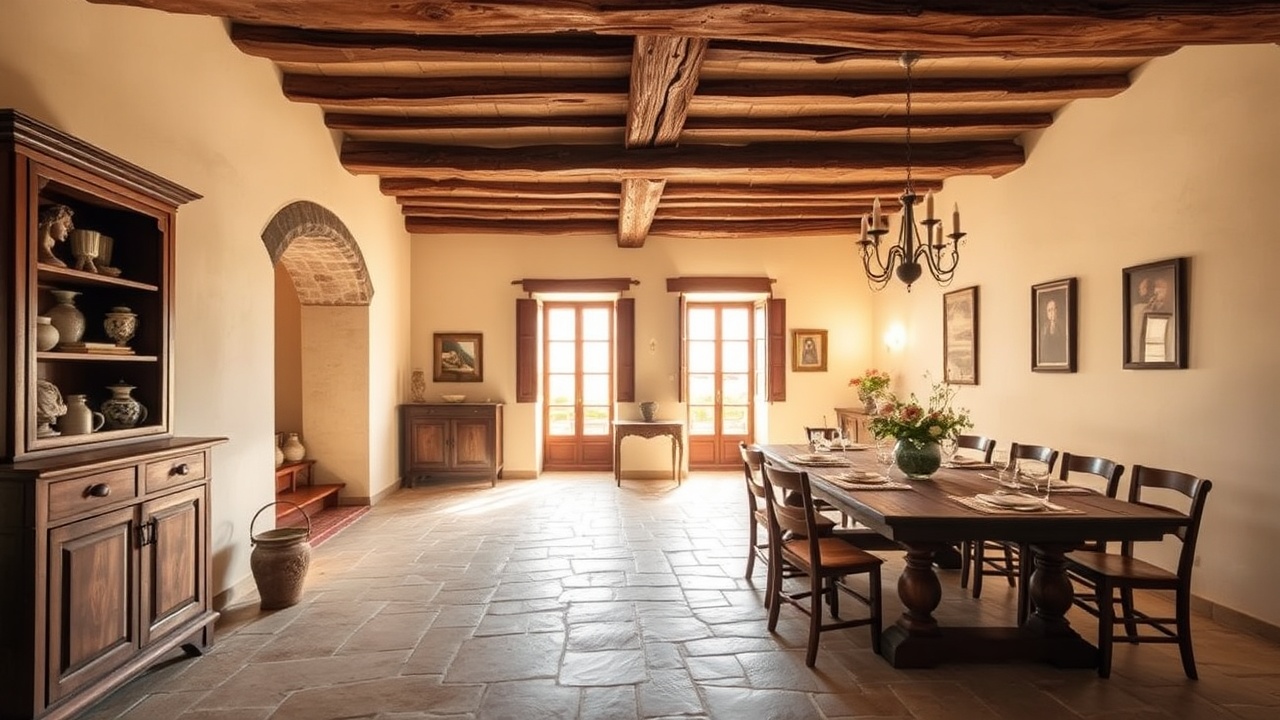
We started by taking things away. The first month was mostly removal: tile that shouldn't have been there, partition walls that had been added in the 1980s to subdivide rooms that didn't need subdividing, fitted storage that blocked natural light from the west-facing courtyard. Underneath the 1990s renovation, the original pietra serena floors were largely intact. We had them lifted, cleaned, and relaid in the original pattern.
The key material decision was the exterior render. Previous repairs had used cement-based mixes on a building that had been built and maintained with lime for six hundred years. The cement was causing salts to migrate through the stone and the structural plaster was failing in four places. We stripped the cement patches and matched the original lime formulation as closely as we could, working with a restoration plasterer from Siena who had done similar work on historic buildings in the region.
For the interiors, we worked from what was already there. The chestnut ceiling beams in the main salon were original and in excellent condition — we cleaned them and left them. The stone fireplace in the kitchen building had been partially bricked up; we opened it again and had a local blacksmith fabricate a simple iron fireback. The linen for the main bedroom came from a cooperative in Anghiari that has been producing fabric for the region since the 1970s. We visited twice and chose a weight and weave we hadn't seen in their catalogue — they make it to order in minimum runs of 60 metres.
The kitchen problem
The kitchen had been the subject of two previous renovations and still didn't work. The issue was structural: a chimney breast on the north wall took up exactly the space where the cooking zone needed to be, and every attempt to work around it had produced a layout that forced whoever was cooking to stand with their back to the room and the view.
Our solution was to accept the chimney and incorporate it. We built the cooking zone into the chimney breast itself — a recessed alcove with a custom range hood designed to look like an extension of the original masonry. The island was moved to the centre of the room, which freed up the south wall for storage and gave the kitchen a social configuration it had never had. The countertop is a single piece of Pietra di Luserna, sourced from a quarry in Piedmont — a blue-grey schist that picks up the tones in the pietra serena floors without matching them too precisely.
What we learned
This project took fourteen months and ended up running 11% over budget — entirely because of the lime render remediation, which was more extensive than our initial survey had suggested. (Cement patches on historic buildings are like icebergs: what you can see is not the whole problem.) We're transparent about that. It's the kind of cost that's very hard to predict without opening up the wall, and by the time we knew the extent of the problem, stopping wasn't a realistic option.
The clients were understanding. When we walked through the finished building in March 2025, the husband said it looked like a house that had been looked after well, which is the best possible thing to say about a restoration.